Before you buy a single stone, decide on a style — it dictates your hardscape, plants, fish and how much maintenance you're signing up for. The main aquascaping styles, what defines each, and how to choose.
Before you buy a single stone, decide on a style. It shapes almost everything that follows — your hardscape, which plants you choose, which fish suit the layout, and how much maintenance you're signing up for. These are the main aquascaping styles, what defines each one, and how to pick.
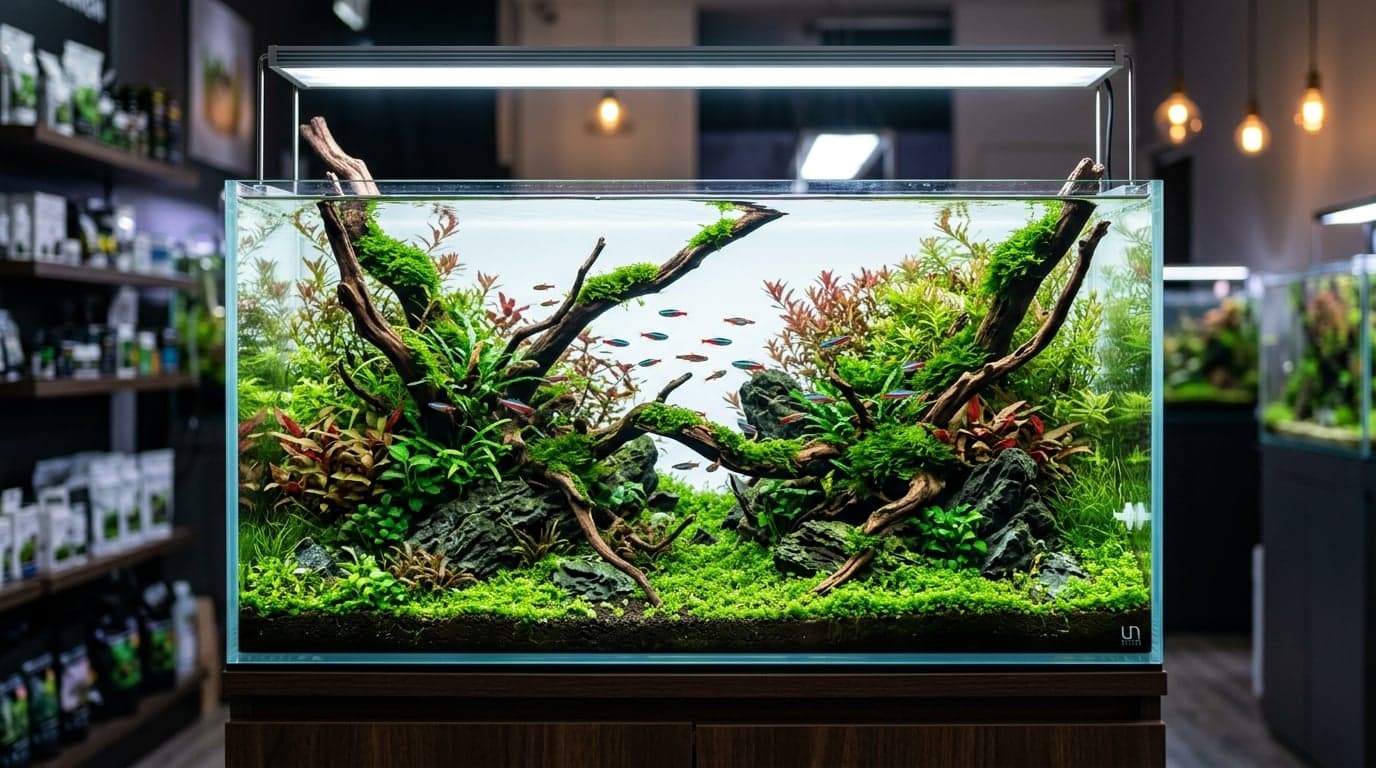
Popularised by Takashi Amano, founder of ADA (Aqua Design Amano) in Japan, the Nature Aquarium style recreates landscapes from nature — forests, riverbanks, hillsides — using wood, stone and plants arranged to look grown rather than placed. It favours asymmetry, a sense of depth, and restraint: fewer species used well rather than a little of everything. It's the style our Vijayanagar studio specialises in, and the focus of our Nature Aquarium Masterclass.
Iwagumi is a Japanese rock-based layout — the name combines "iwa" (rock) and "gumi" (grouping). It uses stones only, no wood, usually in an odd number: one dominant main stone, called the oyaishi, supported by smaller stones that follow its angle and texture. Planting is kept to one or two species, typically a carpet such as Monte Carlo or dwarf hairgrass, and the fish are usually a single schooling species. Seiryu stone is the classic choice. Iwagumi looks simple but is one of the hardest styles to keep perfect: open carpets need CO2 and strong light, and any algae shows immediately.
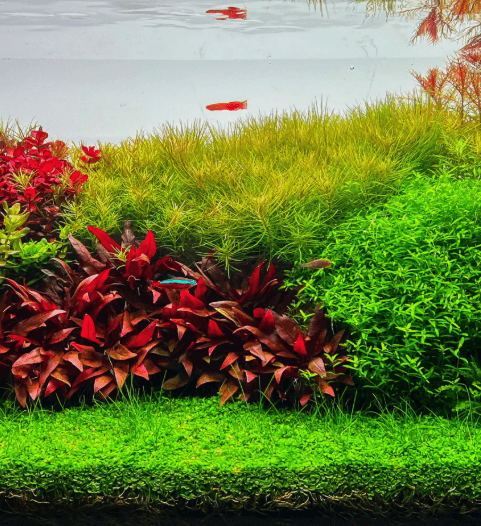
The Dutch style is an underwater garden with little or no hardscape. Many species of stem plants are arranged in rows and terraces, contrasting in colour, leaf shape and height so each group stands out from its neighbours. It needs frequent trimming, strong light, CO2 and a full fertiliser routine — rewarding, but a real commitment.
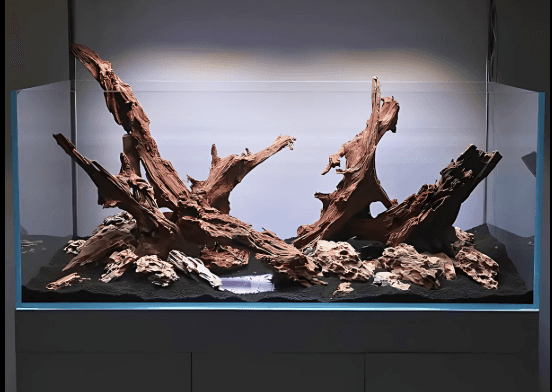
Dense, wild and deliberately untamed. Plants grow tall and reach the surface, floating plants dapple the light, and roots and wood tangle through the layout. Because it doesn't depend on a flawless carpet or precise trimming, jungle style works well with hardy, low-light plants and is the most forgiving style for beginners — our easy plants guide is a good starting list.
A biotope recreates one specific natural habitat — for example, a South American blackwater stream with leaf litter and tea-coloured water — using only plants, fish and materials that belong to that place. It's research-driven, and more about accuracy than artistic composition. For a general tannin-stained look without full biotope rules, botanicals such as casuarina pods release tannins as they soak.
| Style | Hardscape | Plants | Maintenance |
|---|---|---|---|
| Nature Aquarium | Wood and/or stone | Mixed: mosses, carpets, stems | Medium to high |
| Iwagumi | Stone only | One or two species, usually a carpet | High |
| Dutch | Little or none | Many stem plants in rows | High |
| Jungle | Wood and roots | Dense, tall and floating | Low to medium |
| Biotope | Materials from one habitat | Only species from that habitat | Varies |
Jungle style is the most forgiving: it uses hardy, often low-light plants, tolerates imperfection, and doesn't depend on a flawless carpet. Iwagumi and Dutch are the hardest because every trimming mistake or algae problem shows.
A Japanese rock-based layout using stones only — typically an odd number, with one dominant main stone and smaller supporting stones — planted with just one or two species, usually a carpet. The name combines 'iwa' (rock) and 'gumi' (grouping).
Nature Aquarium recreates natural landscapes with wood, stone and plants arranged to look grown rather than placed. Dutch style uses little or no hardscape and arranges many stem plants in contrasting rows, more like a formal garden.
It depends on the style. Jungle and many Nature Aquarium layouts can be grown low-tech with hardy plants, while Iwagumi carpets and Dutch stem-plant layouts generally need injected CO2, strong light and regular fertilising.
Understand the physics of high turn-over biological canisters & hardscaping in our next 2-day session.