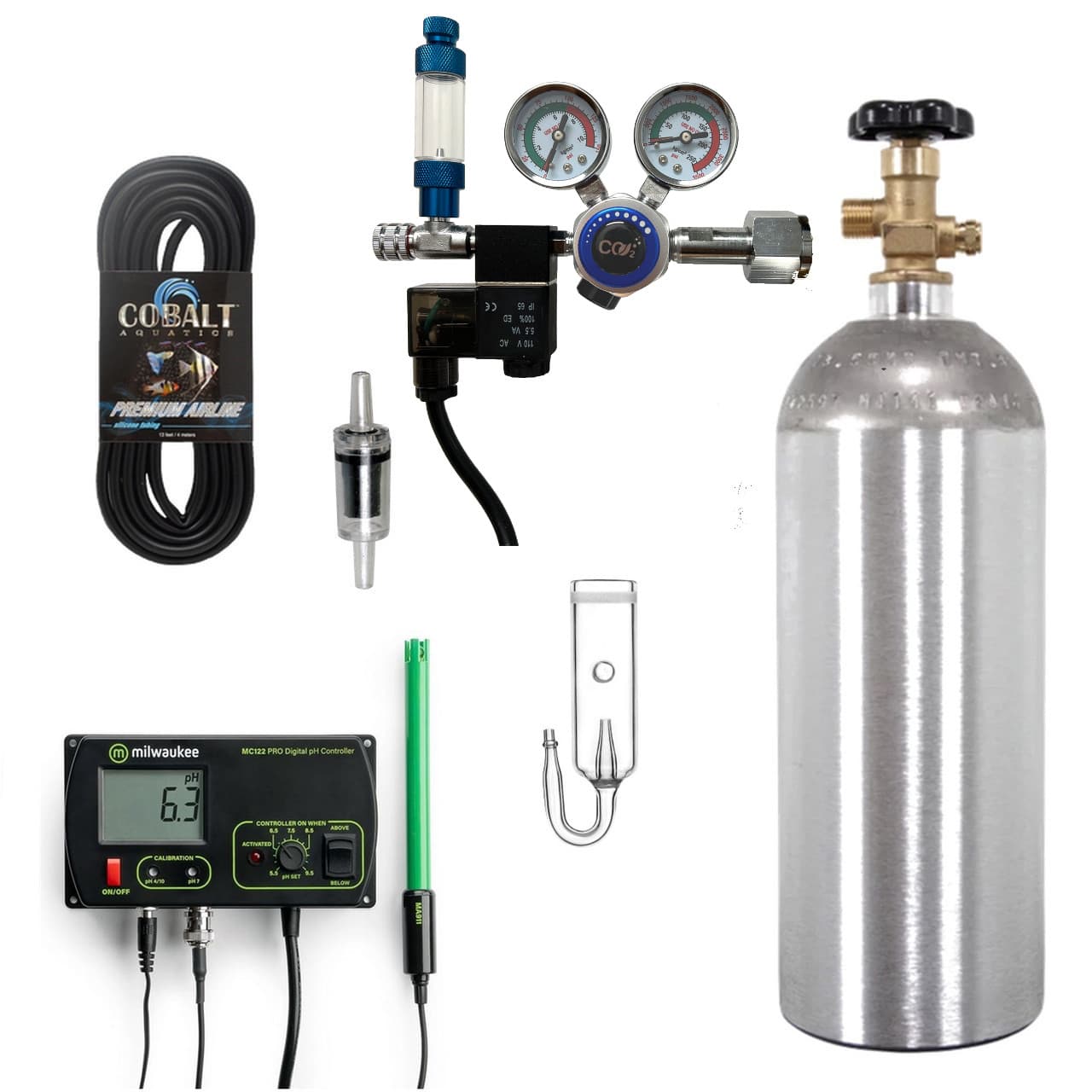
CO2 injection and filtration are the two invisible systems that decide whether a planted tank thrives or stalls. Bubble rates, drop checkers, turnover rates, and the mistakes that send fish gasping at the surface.
Lighting gets all the attention when people plan a planted tank, but CO2 and filtration are what actually determine whether that light produces lush growth or an algae-covered mess. Plants need CO2 in roughly the same proportion they need light — more of one without more of the other just invites algae — and your filter is what keeps that CO2, along with nutrients and oxygen, moving evenly through the tank. Here are the 10 things that separate a stable high-tech setup from a stressed one.
Drop checker colours: yellow = CO2 too high, immediate risk to livestock; green = well-dissolved, safe target range; blue = too little CO2 for strong plant growth. Aim for a pH drop of roughly 1 full point between lights-off and peak CO2 injection as a rough cross-check alongside the drop checker. Timer schedule: CO2 on 1 hour before lights, off 1 hour before lights-off, so plants have dissolved CO2 available for the entire photosynthetic period without wasting gas in darkness.
Turnover target: 4-6x tank volume per hour for a planted tank (lower for shrimp-only tanks with a sponge pre-filter). Media order front-to-back: mechanical (foam/floss) → biological (bio-rings/ceramic media) → chemical (Purigen/carbon, optional). Cleaning schedule: rinse mechanical media every 1-2 weeks in tank water, touch biological media as little as possible — once every 2-3 months at most, and only a light rinse in removed tank water.
Fish gasping at the surface after raising CO2: turn off the CO2 solenoid immediately, add an airstone or increase surface agitation, and re-introduce CO2 more gradually next time with closer drop-checker monitoring. Algae blooming despite "enough" CO2 on paper: the imbalance is usually light outrunning CO2, not CO2 being too low in absolute terms — try reducing photoperiod or light intensity before adding more gas. Biological filter crash after a deep clean: this is almost always from rinsing bio-media in tap water or replacing all media at once — always stagger media replacement and rinse only in dechlorinated or removed tank water.
A drop checker is a small glass bulb with 4dKH indicator solution that sits inside the tank and shows dissolved CO2 by colour: yellow means too much CO2 (risk to fish), green means a safe, effective range, and blue means too little CO2 for strong plant growth.
Start around 1 bubble per second per 100 litres and adjust gradually while watching a drop checker and your fish's behaviour — bubble rate alone doesn't tell you how much CO2 is actually dissolving, since that depends on your diffuser and flow.
Aim for 4-6x the tank's volume per hour for a planted tank, higher than the 2-4x typical for fish-only setups, since the filter is also circulating CO2 and nutrients. Shrimp tanks should run lower flow with a sponge pre-filter.
Repeated surface gasping usually means CO2 has been raised too high and is displacing dissolved oxygen. Turn off CO2 immediately, add an airstone or increase surface agitation, and reintroduce CO2 more slowly next time with closer drop-checker monitoring.
Understand the physics of high turn-over biological canisters & hardscaping in our next 2-day session.