The old 'one inch of fish per gallon' rule breaks down fast in real tanks. What actually limits stocking is filtration, surface area, and adult size — here's how to work it out properly by tank size.
The question we get asked more than any other in-store is some version of "how many fish can I put in this?" — and the honest answer is never a single number, because tank volume is only one of four things that actually decide it. Here's how to work out real stocking capacity instead of guessing from a rule of thumb that was never designed for the fish most people keep.
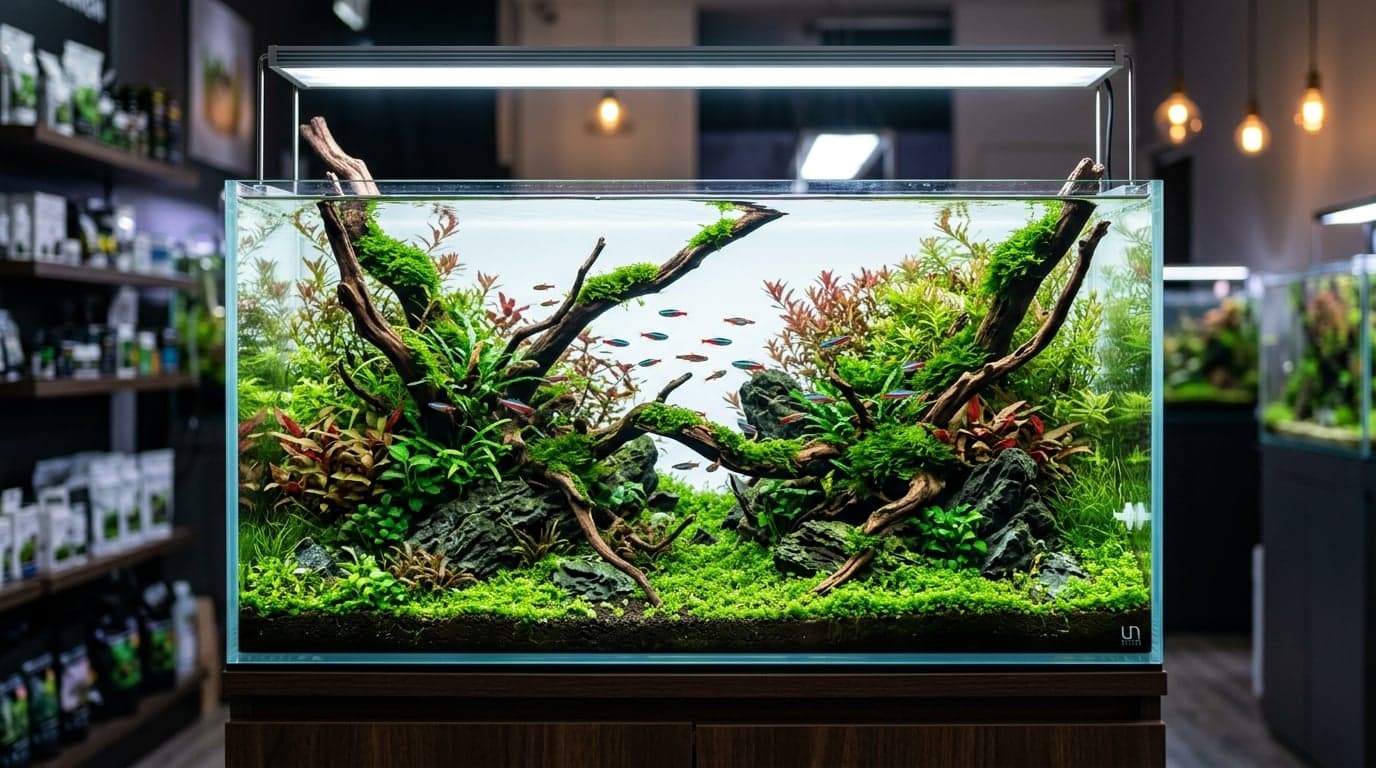
These are conservative starting points for a filtered, cycled community tank with adequate plants — always check the adult size and school requirements of the specific species you're choosing. 1.5ft (~35-45L): a small school of 6-8 tiny fish such as neon tetras or ember tetras, no large or territorial species. 2ft (~55-65L): 8-10 small community fish, or 6 tetras plus a small corydoras group. 2.5ft (~100-110L): a genuine community setup — two schools (e.g. 8 tetras + 6 corydoras) plus one or two centerpiece fish. 3ft (~150-160L): comfortable room for 3-4 species in appropriate school sizes, or one larger centerpiece fish (angelfish, medium gourami) alongside smaller schools. 4ft (~220-250L): supports a genuinely mixed community, a small semi-aggressive cichlid setup, or a single larger specimen fish with generous swimming room.
Buying juveniles and outgrowing the tank within a year: always look up adult size before purchase, not just current size — ask our staff if a species' full-grown size isn't marked on the label. Ammonia spike after adding several fish at once: stop feeding for 24-48 hours, do a 25-30% water change, and resume adding fish in smaller batches with longer gaps between them. Aggression or stress in a "correctly sized" tank: check whether a territorial or shoaling species has been under-grouped or under-spaced — the fix is often behavioral (group size, hiding spots, sightline breaks with plants/hardscape), not simply a bigger tank.
Not reliably — it assumes every fish has the same body shape and produces the same waste per inch, which isn't true. A slim tetra and a deep-bodied goldfish of the same length have very different bioloads, so treat the rule as a rough sanity check at most, not an actual stocking plan.
As a conservative starting point, a well-filtered, cycled 2ft tank (roughly 55-65 liters) suits about 8-10 small community fish, such as a school of tetras plus a small corydoras group — always check the adult size of each species first.
Tetras, corydoras, rasboras, and similar schooling species experience stress and higher illness rates in groups smaller than 6. Their full group's bioload should be planned into your stocking from day one rather than adding a couple now and more later.
No — add fish in small batches over 2-4 weeks, testing ammonia and nitrite between additions. Adding a full stocking list on day one can overwhelm even an established filter's bacterial colony and trigger a mini ammonia spike.
Understand the physics of high turn-over biological canisters & hardscaping in our next 2-day session.