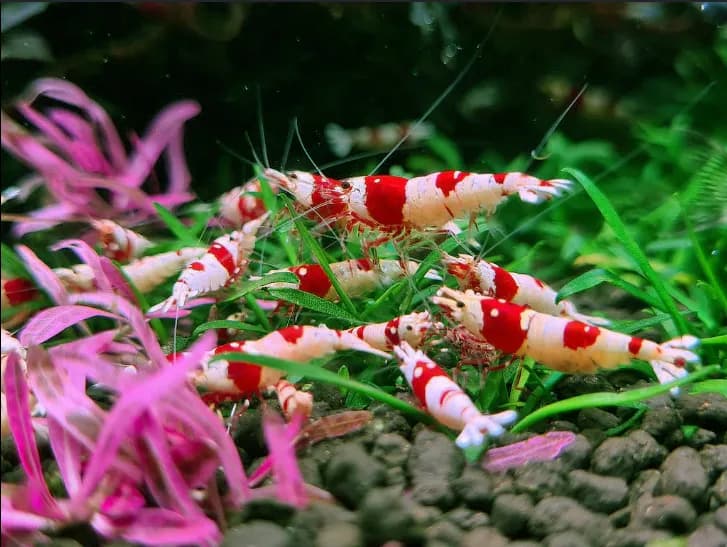
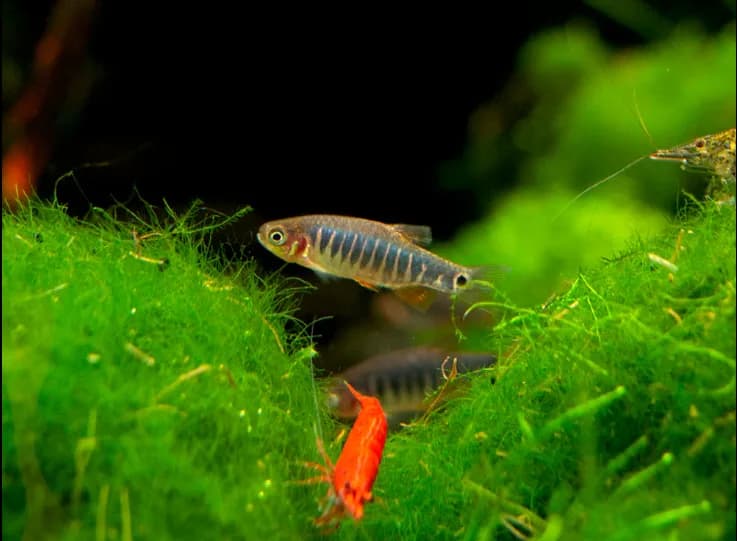
Discover Danio erythromicron, a stunning micro-predator exhibiting beautiful gold and blue vertical stripes. Excellent choice for detailed and dense nano aquascaped tanks.
Danio erythromicron, commonly called the Emerald Dwarf Rasbora, is a miniature gem from the clear, alkaline waters of Lake Inle in Myanmar. Maxing out at just 2 cm, these fish punch far above their size with vivid emerald-blue vertical stripes, an orange-gold body, and remarkably bold personalities for such tiny creatures. They are often mistaken for Celestial Pearl Danios (CPDs), but erythromicron is slimmer, more active in open water, and carries a distinctly different iridescent quality in its striping. In a mature, well-planted nano aquascape, a group of 10-15 erythromicron creates one of the most visually spectacular displays in freshwater fishkeeping.
Their size is a gift for aquascapers. At 2 cm maximum, a school of 12 fish creates visual mass without overwhelming a 30-40 litre nano tank. Unlike larger schooling fish, they never disturb a carefully planted foreground or knock over hardscape. In Iwagumi-style layouts — open sand foreground, mid-height stone arrangement, minimal planting — their silver-and-emerald colouring provides the perfect contrast against the pale substrate and green carpet plants. In Dutch-style or Wabi-Kusa arrangements, they weave between stem plants in mesmerising synchronised movements.
A 30-45 litre tank (approximately 40 x 30 x 30 cm) is ideal for a group of 10-15 fish. Substrate options: ADA La Plata sand (white, contrasting brilliantly with their colouring), or Tropica Aquarium Soil for a planted layout. Filtration: a gentle sponge filter or a small canister filter with a spray bar output directed at the glass rather than open water — strong current stresses these fish. They come from a slow-moving lake, not a stream. Temperature: 22-26 degrees Celsius. Avoid tanks with strong flow or aggressive surface agitation.
CO2 injection enhances plant growth dramatically in an erythromicron tank, but the fish are sensitive to sudden CO2 crashes. Set up a drop checker (yellow = too high, green = correct) and ensure your CO2 timer activates 1 hour before the lights come on and switches off 1 hour before lights off. A mature tank with stable parameters will see erythromicron spawning regularly — they scatter eggs among fine-leafed plants, and fry will appear if predation is low.
Target: pH 7.2-7.8, TDS 150-250 ppm, Temperature 22-26 degrees Celsius, GH 6-10, KH 3-6. Ammonia and nitrite should always read zero. Nitrates below 20 ppm. Weekly 15-20% water changes with dechlorinated tap water (if your tap water is moderately hard) or remineralised RO water work well. Unlike Caridina shrimp, erythromicron tolerate a moderate parameter range — the key is stability and the absence of extremes.
Feed twice daily — morning and evening — using micro-sized foods only. Weekly rotation: Monday and Thursday — crushed Hikari Micro Pellets or Vitalis Nano Pellets, Tuesday and Friday — live or frozen baby brine shrimp (thaw and rinse frozen BBS before feeding), Wednesday — GlasGarten Bacter AE dose (benefits any shrimp in the tank too), Weekend — micro worm culture or daphnia (excellent conditioning food that triggers spawning behaviour). Avoid overfeeding — erythromicron are slow, deliberate feeders, and excess food quickly degrades water quality in a nano tank.
Erythromicron are best kept in species-specific tanks or with very carefully chosen companions. Ideal choices:
Avoid any fish over 4-5 cm, fish with large mouths, and particularly avoid nippy species. Erythromicron are too small and too delicate for community tanks with typical medium-sized fish.
Danio erythromicron reaches a maximum of about 2 cm, which makes it ideal for nano tanks. A group of 10-15 suits a 30-45 litre tank.
They come from Lake Inle in Myanmar and prefer moderately hard, slightly alkaline water: pH 7.2-7.8, GH 6-10, KH 3-6, at 22-26°C. Stability matters more than hitting exact numbers.
Micro-sized foods only — their mouths are too small for standard flake or pellets. Crushed micro pellets, baby brine shrimp, microworms, daphnia and biofilm powders such as GlasGarten Bacter AE work well, fed twice a day.
No, though they're often confused. Danio erythromicron is slimmer, more active in open water, and has emerald-blue vertical stripes on an orange-gold body. The two species are compatible and can share a tank.
Understand the physics of high turn-over biological canisters & hardscaping in our next 2-day session.